
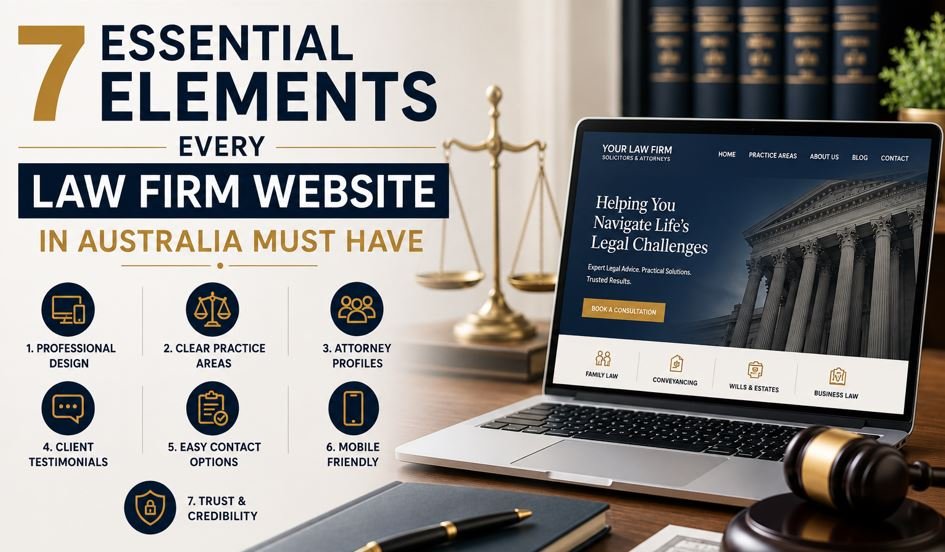
The digital landscape has reshaped how clients search for and engage legal services. A professionally designed law firm website is now a critical asset for building trust, expertise and generating new client enquiries. Effective law firm web design helps Australian law firms establish credibility, enhance online visibility and remain competitive in an increasingly digital marketplace.
This guide explores the seven essential elements of a high performing law firm website and how they contribute to attracting prospective clients, strengthening your brand and driving long-term business growth.
1. Comprehensive Information Architecture and Intuitive User Navigation
Effective information architecture plays a key role in improving user experience and conversion rates in law firm web design. A law firm website should be structured logically, allowing visitors to find information quickly and easily. Especially as users form opinions within seconds.
The navigation should be clear and well-organised, with content grouped according to practice areas, client needs and legal queries. The contact details should be easy to find within the website, appearing in the header, footer and key pages.
Key best practices include:
- Limiting main navigation to 5–7 categories
- Using breadcrumb trails for easy navigation
- Maintaining consistent menus across pages
- Ensuring mobile-friendly navigation
- Adding search functionality for larger sites
High-performing websites also use sticky headers to keep contact details accessible. Contact forms should be simple, asking only for essential details such as name, email, phone and enquiry type. Keeping forms concise reduces friction and significantly improves enquiry rates.
2. Credibility Markers and Professional Trust Indicators
Trust is a decisive factor when clients choose a law firm. Before engaging services, users assess credibility through visible signals on the website. Elements such as professional credentials, testimonials and social proof play a crucial role in influencing decisions.
Key trust-building components include:
- Detailed lawyer profiles with qualifications and experience
- Licensing details and bar admissions
- Certifications and areas of specialisation
- Client testimonials highlighting real outcomes
- Years of practice and firm history
- Memberships in professional associations
- Awards and industry recognition
- Professional team photographs
Strong presentation directly enhances client confidence. Profiles should clearly outline expertise and background, while testimonials are most effective when they showcase specific problems solved and measurable results.
Security indicators are equally important. Displaying SSL certificates, privacy badges and data protection assurances reassures users that their information is handled securely, increasing trust and encouraging enquiries.
3. Responsive Design Implementation Across All Digital Devices
Mobile responsiveness has transitioned from an optional enhancement to essential requirement. Australian usage patterns indicate that approximately seventy-five percent of legal research now occurs on mobile devices. Your law firm website design must perform flawlessly across smartphones, tablets and desktop environments simultaneously.
Responsive design principles require rigorous testing across multiple platforms:
- iPhone devices running current and previous iOS versions
- Android devices from various manufacturers
- Tablets in both portrait and landscape orientations
- Desktop displays at multiple resolution standards
- Different browsers including Chrome, Safari, Firefox and Edge
Page load speed directly influences search rankings and user experience significantly. Website design for law firms should maintain load times under three seconds consistently. Optimise images, minify code and implement efficient content delivery networks. Google prioritises fast-loading websites in search results, directly impacting visibility and ranking positions.
The best law firm websites implement progressive enhancement strategies effectively. Core functionality operates effectively on older devices whilst newer technologies enhance experience for modern browsers. This approach ensures accessibility whilst maintaining cutting-edge performance standards.
4. Strategic Content Development and Educational Resource Provision
High-quality content is essential for demonstrating legal expertise and improving search visibility. As a core element of law firm web design, a law firm’s website should consistently address common client questions and provide clear, informative resources that build trust and authority.
Key content areas include:
- Practice guides explaining legal concepts
- Clear process explanations for legal matters
- Frequently asked questions with detailed answers
- Updates on legal and regulatory changes
- Case studies showcasing successful outcomes
- Blog content on emerging legal topics
Content must be updated regularly to remain relevant. Outdated information can harm credibility, so fresh content should be published at least twice a month, with immediate updates when laws or procedures change.
A structured content plan is highly effective. Content should serve both client needs and search optimisation goals, using clear headings, subheadings and bullet points to ensure readability across all devices.
5. Detailed Service Description Pages and Conversion-Focused Formatting
Individual service pages represent critical conversion points within law firm websites. Each practice area requires dedicated pages with comprehensive service descriptions, process explanations and client value propositions. These pages bridge the gap between general awareness and specific engagement effectively.
Each service page should contain:
- Detailed explanation of legal services provided
- Step-by-step process overview for typical matters
- Timeline expectations and matter duration information
- Common questions and detailed responses
- Client testimonials specific to that practice area
- Clear calls-to-action directing visitors toward enquiry
Law firm website design must distinguish your practice clearly from competitors in your market. Explain your unique methodology and philosophical approach to legal representation effectively. Share specific case studies demonstrating tangible results achieved for previous clients consistently.
6. Search Engine Optimisation Strategy and Technical Implementation
Being visible in search engines is critical for attracting potential clients to a law firm, as most people begin their search for legal services online. A law firm’s website must incorporate a well-planned SEO strategy across all pages of the site to improve search engine rankings and to increase the amount of relevant traffic to the website.
Key optimisation practices include:
- Using targeted keywords in titles and meta descriptions
- Maintaining a clear heading structure (H1, H2, H3)
- Optimising images with descriptive alt text
- Ensuring mobile-first design and performance
- Implementing structured data for local business details
- Creating strong internal linking between pages
- Focusing on local SEO for geographic targeting
Local optimisation is particularly important. Creating dedicated location pages and including suburb names, regions and local references helps capture high-intent searches such as “solicitor near [area]”.
Additionally, content should be structured to answer common questions clearly, increasing the chances of appearing in featured snippets and AI-driven search results, ultimately improving visibility and enquiry rates.
7. Advanced Security Infrastructure and Data Protection Mechanisms
Legal practice websites handle confidential client information requiring exceptional security protocols. As an essential aspect of law firm web design, Australian privacy legislation mandates robust data protection practices throughout website operations. Strong security features build client confidence and demonstrate compliance with professional obligations.
Implement these security measures:
- SSL encryption certificates with visible security indicators
- Secure contact forms with encrypted data transmission
- Regular security audits and vulnerability assessments
- Compliance with Australian Privacy Principles
- Clear privacy policy documentation
- Data backup systems and disaster recovery procedures
- Firewall protection and intrusion detection systems
Law firm website developers prioritise security above aesthetic considerations consistently. Visible security indicators including SSL certificates and privacy badges significantly increase user confidence. Display your privacy commitment prominently throughout the website design for law firms. Explain specifically how client information receives protection.
Final Words
Successful law firm website design requires integrated coordination across all seven elements comprehensively. These components function synergistically, creating comprehensive digital experiences that attract, educate and convert potential clients into engaged customers successfully.
Your law firm web design represents your most scalable marketing investment available. Professional websites operate continuously, attracting qualified enquiries outside traditional business hours consistently.
Partner with Law Firm Website Design to build a high-performing website that strengthens your online presence and drives consistent client enquiries. Our team creates the best law firm website design solutions, combining professional aesthetics, seamless functionality, and proven conversion strategies for long-term success.
Frequently Asked Questions
Q1: How much time should law firm websites spend on practice area pages?
Dedicate substantial space to each practice area. Explain the process clients experience. Share common concerns people raise. Provide answers to questions your team hears regularly. Include relevant case studies showing your expertise and results. This depth builds authority and converts visitors into enquiries, making practice area pages crucial for law firm website development success.
Q2: What makes the best law firm websites different from average ones?
Quality websites respond to what visitors want. They answer questions clearly. They build trust through credentials and testimonials. They load quickly on phones. They include strong calls to action. Average websites ignore user experience. Great websites prioritise client needs throughout the web design for law firm services.
Q3: Why should law firm web designers focus on local search optimisation?
Most legal clients search locally. They want help nearby. Optimising for location terms helps local clients find you first. Include your suburb and region in key places. Create location-specific pages if you service multiple areas. Local optimisation drives quality enquiries for law firm websites serving specific regions and communities.
Q4: How frequently should law firm websites get updated with new content?
Publish fresh content at least twice monthly. Update service pages when laws change. Refresh testimonials and case studies regularly. Fix outdated information immediately. Search engines favour websites that change regularly. Content updates demonstrate your law firm web design remains current and trustworthy to both visitors and search algorithms consistently.